February 19, 2026

The Health Tradeoffs Behind Plastic Circularity
Recycling has become the default response to plastic waste. In healthcare, it is often framed as the responsible path forward—reduce landfill impact, close the loop, and move toward a circular economy. But this focus on recycling raises a critical and often overlooked question: what happens when the material we are trying to keep in circulation carries health risks of its own?
What a “Circular Economy” Is Supposed to Do
A circular economy is a system where materials never become waste and nature is regenerated. It aims to eliminate waste by keeping materials in use through reuse, recovery, and recycling. In theory, it offers an elegant alternative to the linear “take–make–dispose” model, one that reduces environmental impact by extending the life of materials already in circulation.
Plastic became central to this vision because it is inexpensive, durable, and widely recyclable in theory. As a result, recycling has been positioned as the primary sustainability solution for plastic-based products, including healthcare packaging.
However, plastic does not become inert simply because it is recycled. From chemical additives to microplastic shedding, its interaction with medications and patients can persist across multiple lifecycles. This is the Circularity Paradox: a material can be kept in circulation and still carry health-related risks. Recycling alone, therefore, does not guarantee that healthcare packaging is safe but only reused.
In practice, circularity discussions focus heavily on waste reduction and carbon impact, while often overlooking human exposure to harmful chemicals. Global institutions, including the United Nations Environment Programme, have noted that plastics contain thousands of chemicals, many of which are not fully assessed for long-term health effects. The material itself carries risk, regardless of whether it ends up in a landfill or a recycling bin.

Recycling Became the Default Solution
Recycling is often presented as the primary solution to plastic pollution. The reasoning is straightforward: if plastic can be collected and reused repeatedly, its environmental harm is reduced and the material becomes sustainable.
Recycling is particularly appealing because it does not require fundamental changes to product design or manufacturing systems. It is a downstream intervention, addressing waste after a product is used while allowing upstream production of plastic to continue largely unchanged. For many industries, including healthcare, this has made recycling the most accessible sustainability strategy.
However, the limitations of this approach are increasingly acknowledged. Major global institutions have emphasized that plastic pollution is a growing environmental and public health challenge, and that addressing it requires systemic change, not onlyimproved end-of-life management. Focusing exclusively on recycling risks overlooking other dimensions of harm.
Recycling Still Poses Health Risks
Circularity discussions tend to emphasize metrics such as waste reduction, carbon footprint, and litter prevention. Far less attention is paid to a critical healthcare question of how the prolonged circulation of plastic affects human health.
When plastic remains in use across multiple lifecycles, its interaction with people does not disappear. Instead, opportunities for exposure can accumulate.
Plastic can expose humans in two primary ways:
- Particles: microplastics and nanoplastics released through abrasion, aging, and repeated handling
- Chemicals: additives and contaminants that can migrate from the material over time
In 2022, researchers reported detecting plastic particles in human blood, demonstrating that microplastics can enter the bloodstream. Subsequent studies continue to confirm the presence of microplastics in the human body, even as the full health implications are still being investigated.
Importantly, recycling does not eliminate these exposure pathways. In some cases, recycled plastics may introduce greater chemical variability, as materials from multiple sources are combined. From a healthcare perspective, this variability raises additional questions about long-term safety, particularly in applications involving frequent or prolonged patient contact.
Medication Packaging Deserves Special Attention
Medication packaging is not a short-term point of contact. Pill bottles may store drugs for months while being exposed to heat, humidity, friction, and repeated handling conditions that can influence both particle shedding and chemical migration over time. Unlike many consumer packages, medication containers are designed for frequent daily interaction across extended periods.
Because packaging can directly affect drug quality and patient safety, regulators treat pharmaceutical containers as safety-critical components of the product. The industry is increasingly adopting structured frameworks to evaluate extractables and leachables (E&L)—chemicals that can come out of packaging and contact the drug product. The FDA’s draft guidance tied to ICH Q3E describes a holistic process for assessing and controlling E&L.
Concerns about plastic exposure in healthcare are supported by emerging evidence. Research reported by the American Chemical Society found that plastic medical infusion bags can release thousands of microplastic particles into solutions intended for direct delivery into the bloodstream. While infusion bags differ from pill bottles in form and use, the finding underscores a broader principle: plastic materials in medical environments can create direct exposure pathways.
Rethinking Sustainable Healthcare Packaging
True sustainable healthcare packaging must consider both environmental impact and human exposure. Reducing waste is important, but sustainability in healthcare cannot stop at end-of-life outcomes; it must also account for what patients and medications are exposed to during use.
Regulatory frameworks already reflect this broader perspective. USP standards and FDA guidance emphasize evaluating packaging materials for patient safety, including the risk of chemical migration and long-term exposure. These expectations point toward a more complete definition of sustainability one that includes:
- chemical safety
- exposure reduction
- real-world recyclability
By contrast, “sustainable packaging” is often narrowly defined as being recyclable, lightweight, or lower in carbon footprint. While these attributes matter, they are not sufficient on their own in healthcare contexts.
In many cases, paper-based systems offer meaningful advantages. They benefit from established recycling infrastructure, clearer material streams, and the opportunity to design out unnecessary plastic particularly in applications involving daily, long-term patient contact.
Spotlight on Tully Tube: The Ultra-Sustainable Pill Bottle
All of these benefits come to life in the Tully Tube, the world’s only ultra-sustainable pill bottle. Unlike conventional bottles, which are made almost entirely of plastic, Tully Tube is built with paper and fiber-based materials that embody the best of what paper has to offer.
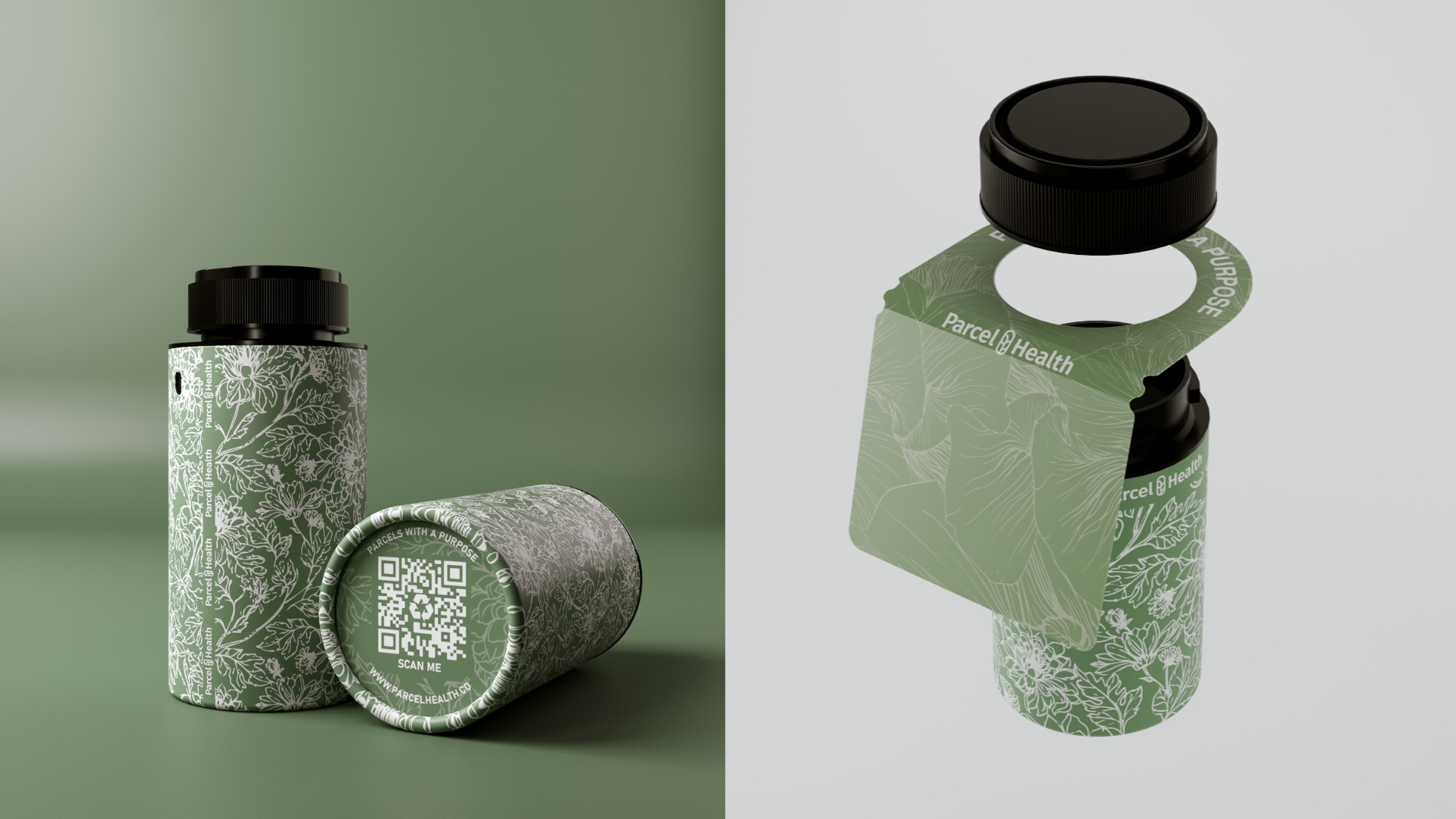
- Renewable by Design: Tully Tube relies on sustainably-sourced cellulose fibers, aligning with the renewable raw material advantages described by Bio Based Press. This reduces reliance on petroleum-based plastics.
- Recyclable and Biodegradable: With the majority of its structure designed for easy recycling and clean decomposition, Tully Tube fits seamlessly into the circular economy. Patients can dispose of it responsibly without concern for long-lived plastic waste.
- Protective Integrity: By leveraging engineering insights similar to those studied in Frontiers in Built Environment, Tully Tube maintains structural strength and thermal stability. Medicines inside are shielded from environmental stressors, ensuring safety and efficacy.
- Safer for People: By avoiding plastics and their associated risks, Tully Tube delivers on both health and sustainability. Non-toxic inks and adhesives reinforce its safety credentials.
- Trustworthy Experience: Like the simple demonstration in Teach Me Mommy’s experiment shows, paper breaks down cleanly. Patients using Tully Tube know their packaging is designed to disappear naturally, not linger as pollution.
Tully Tube is proof that the choice of packaging can align with the highest standards of safety, sustainability, and human-centered design. It shows that protecting medicine doesn’t have to come at the planet’s expense, and that sustainability can actively enhance patient safety and confidence.
Beyond Recycling
Recycling matters. It reduces waste and can help lower environmental harm.
But the Circularity Paradox is a reminder that a recycled material can still carry risk, particularly in healthcare settings, where packaging comes into repeated contact with medications and patients.
If we want packaging that is better for the planet and better for people, we must look beyond disposal and focus earlier in the lifecycle and starting with safer material choices and intentional design.
Parcel Health welcomes conversation with partners who are rethinking healthcare packaging. Contact us to learn more about our approach and explore potential collaboration.
Others you might like
Check out some of our latest blog posts.
.png)
.jpeg)