July 15, 2026

Why Paper Packaging Beats Plastic on Sustainability

As brands and retailers move away from single-use plastic, paper has emerged as a leading alternative. With both materials so deeply embedded in daily life, it is worth understanding what actually makes paper the more sustainable choice.
Unlike plastic, paper comes from renewable resources: trees that grow back. When forests are managed responsibly, multiple trees are planted for every one harvested. In the US alone, the lumber industry plants 1.7 million trees per day. Certification bodies like the FSC set clear rules for how those forests are managed, protecting habitats, biodiversity, and the communities that depend on them. For brands prioritizing sustainability,FSC-certified paper is the baseline for their product.
Paper vs Plastic: Renewability
The fundamental difference between paper and plastic comes down to what they are made from. Around 98% of single-use plastic is derived from fossil fuels, a finite resource that does not regenerate. Paper, with proper forest management, comes from a continuously renewable source.
Beyond raw materials, paper also has a clear edge in end-of-life. Paper recycling infrastructure is widely accessible to consumers compared to plastic. Plastic’s collection and processing capacity falls far short of the volume produced, so large amounts of plastic still end up in landfills or the environment.
Can Bioplastic Make Plastic More Sustainable?
Bioplastic are increasingly recognized as a meaningful step forward in sustainable materials, offering a cleaner alternative to conventional plastics. Unlike traditional plastics, many bioplastics are derived from organic raw materials, which significantly reduces emissions during production. In healthcare, where single-use materials remain essential for patient safety and regulatory compliance, this upstream emissions reduction matters. Switching to bioplastics where paper isn't an option is a practical way to lower a facility's carbon footprint without compromising care standards.
What Happens to Paper After Use
At the end of life, paper and plastic have different environmental impacts. Paper is biodegradable and is ideally recycled or composted, where its fibers can be recovered or naturally broken down. Conventional plastics do not biodegrade and instead persist in the environment, where they can gradually fragment into microplastics. Plastic resists breakdown for decades to centuries, and when it finally does degrade, it leaves behind microplastic particles that have now been detected in every environment on earth, and inside human brains, blood, and testicles.
Paper vs Plastic in Recycling
The infrastructure for paper recycling is mature, well understood, and widely used.
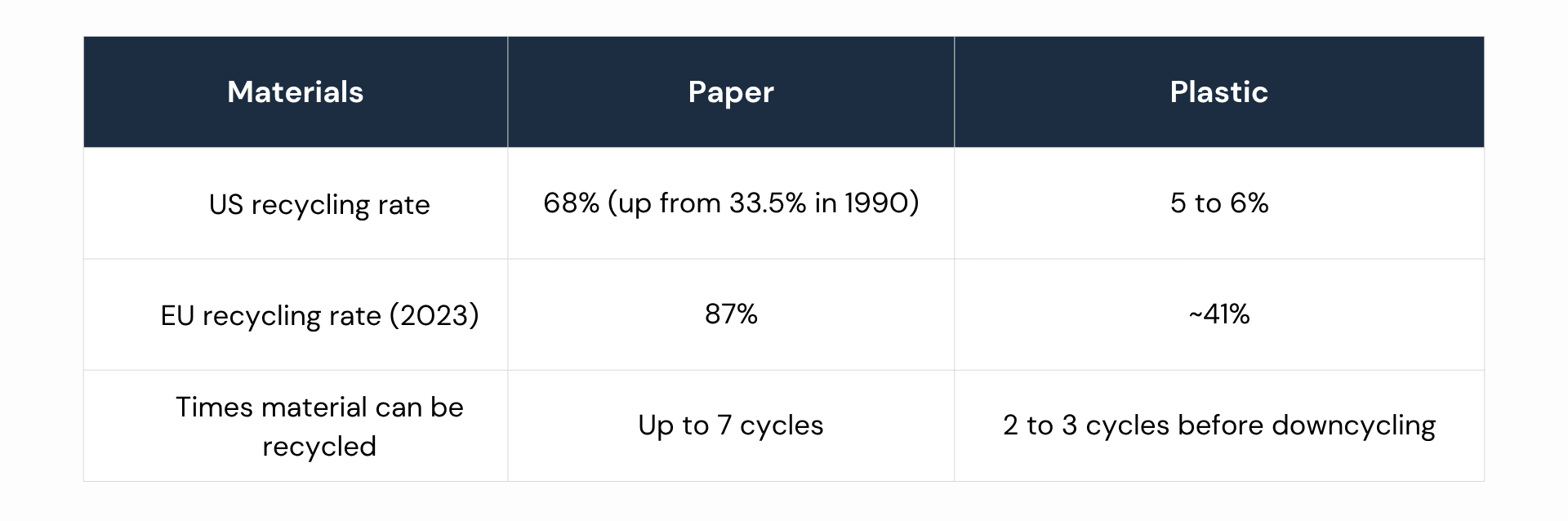
According to the US EPA, recycling one ton of paper saves an estimated 17 trees, 4,000 kWh of energy, and approximately 7,000 gallons of water. Plastic, by contrast, generally loses material quality with each recycling cycle. It can often only be recycled a limited number of times before it is downcycled into lower-value products or requires virgin material to maintain performance. Paper fibers can be recycled multiple times. With each recycling cycle, shorter fibers get redirected into different paper grades, from kraft packaging to newsprint, keeping material in circulation far longer before it exits the loop entirely.
The good news is that recycling infrastructure itself is improving. There are more than 350 materials recovery facilities (MRFs) operating across the US, and AI robotic sorting is now able to triple recovery rates compared to standard manual sorting. Still, this kind of infrastructure investment moves slower than the pace at which bioplastic and mixed-material packaging is entering the waste stream. The most effective place to start the cycle is not at the recycling center, but at the packaging decision itself, choosing materials that don't depend on facilities still being built.
How Parcel Health Is Replacing Plastic in Healthcare
Amber plastic pill bottles, typically made from #5 polypropylene (PP), is the standard packaging used by pharmacies across the US. The major problem is that most of them never get recycled. Parcel Health created Tully Tube to address this problem. Built from FSC-certified paperboard, the Tully Tube replaces the plastic pill bottle with a paper-based alternative designed to meet pharmacy-grade safety and performance standards, including child resistance, humidity protection, and compatibility with pharmacy automation. The paper body can be recycled curbside or composted.
Is Paper Packaging Actually Sustainable?
Yes. Prescription packaging will always be necessary. Using paper, a lower-carbon material with better end of life outcomes than plastic, ensures that patients can receive prescriptions as sustainably as possible. Paper from FSC-certified, responsibly managed forests is renewable, biodegradable, and far more recyclable than plastic. The industry is also improving on the production side, with some mills now generating nearly half their own energy from production waste and achieving zero water discharge.
The best choice for reducing packaging's environmental footprint is certified paper paired with consistent recycling. Paper is not perfect, but compared to materials that can take centuries to break down, pollute ecosystems across the globe, and depend on finite resources, it remains the more sustainable option.
Others you might like
Check out some of our latest blog posts.
.png)
.jpeg)